
Token-2022 vs SPL Token: Which Solana Standard Is Better?
Learn the key differences between Token-2022 and SPL Token on Solana. Compare features, compatibility, use cases, and discover which token standard is best for your next blockchain project.
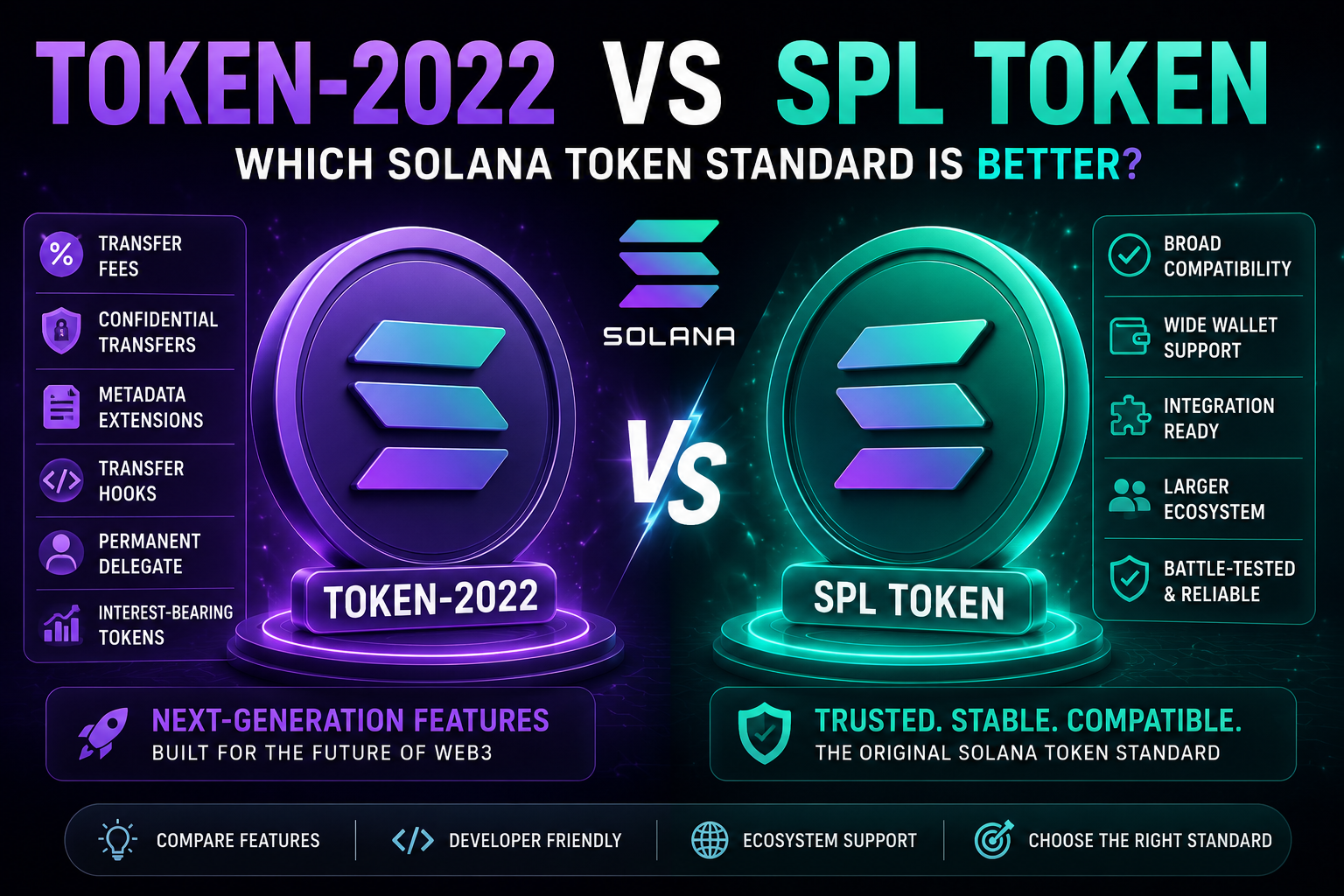
Token-2022 vs SPL Token: Which Solana Token Standard Should You Choose? (2026)
Confused about Token-2022 vs SPL Token? Learn the key differences, supported features, compatibility, and when to use each token standard for your next Solana project.
Table of Contents
- Introduction
- What Is an SPL Token?
- What Is Token-2022?
- Token-2022 vs SPL Token: Key Differences
- New Features in Token-2022
- Compatibility Across the Solana Ecosystem
- Which Token Standard Should You Choose?
- How to Create a Solana Token
- Frequently Asked Questions
- Final Thoughts
Introduction
The Solana blockchain offers developers multiple token standards, with SPL Token being the original and most widely adopted standard. As the ecosystem evolved, the Solana Foundation introduced Token-2022, an upgraded token program that adds advanced features while maintaining a familiar developer experience.
If you're planning to launch a cryptocurrency, meme coin, utility token, or governance token, understanding the differences between these standards is essential.
If you're ready to launch your own token, you can Create Solana Token in just a few minutes using a browser-based token creator—no coding required.
What Is an SPL Token?
An SPL Token is the original fungible token standard on the Solana blockchain.
Similar to Ethereum's ERC-20 standard, SPL Tokens allow developers to create digital assets that can be transferred, traded, and integrated across wallets and decentralized applications (dApps).
SPL Tokens are widely supported by:
- Phantom Wallet
- Solflare Wallet
- Jupiter Exchange
- Raydium
- Orca
- Solscan
- Most Solana DeFi applications
Because of its long history and broad compatibility, the SPL Token Program remains the default choice for many projects.
What Is Token-2022?
Token-2022 is an enhanced version of the original SPL Token Program. Rather than replacing SPL Tokens, it extends the standard by introducing optional features that developers can enable depending on their project's needs.
The goal is to make tokens more flexible without requiring entirely new token standards.
Token-2022 remains compatible with much of the Solana ecosystem, although some advanced extensions require wallet and application support.
Token-2022 vs SPL Token
| Feature | SPL Token | Token-2022 |
|---|---|---|
| Basic Fungible Tokens | ✅ | ✅ |
| Wallet Support | Excellent | Growing |
| Transfer Fees | ❌ | ✅ |
| Metadata Extensions | ❌ | ✅ |
| Transfer Hooks | ❌ | ✅ |
| Confidential Transfers | ❌ | ✅ |
| Interest-Bearing Tokens | ❌ | ✅ |
| Permanent Delegate | ❌ | ✅ |
| Ecosystem Compatibility | Highest | Improving |
New Features in Token-2022
Token-2022 introduces several optional extensions that are unavailable in the classic SPL Token Program.
Transfer Fees
Projects can configure transaction fees that are collected whenever tokens are transferred between wallets.
Confidential Transfers
Privacy-focused projects can take advantage of confidential transfer functionality to help protect transaction details.
Metadata Extensions
Instead of relying solely on external metadata accounts, Token-2022 supports additional metadata functionality directly through extensions.
Transfer Hooks
Developers can execute custom logic whenever tokens are transferred, enabling more advanced decentralized applications.
Permanent Delegate
Projects can assign a permanent delegate account with specific administrative permissions when appropriate.
Interest-Bearing Tokens
Developers can build tokens that support interest accrual through Token-2022 extensions, opening new possibilities for decentralized finance (DeFi) applications.
Compatibility Across the Solana Ecosystem
Although Token-2022 offers powerful capabilities, ecosystem support continues to expand.
Today, standard SPL Tokens generally enjoy broader compatibility with:
- Wallets
- Exchanges
- DeFi protocols
- NFT marketplaces
- Analytics platforms
Before launching a Token-2022 project, verify that the wallets and services your users rely on support the specific extensions you plan to enable.
Which Token Standard Should You Choose?
Your choice depends on your project's goals.
Choose SPL Token if you need:
- Maximum compatibility
- Simple meme coins
- Community tokens
- Exchange listings
- Broad wallet support
Choose Token-2022 if you need:
- Transfer fees
- Compliance features
- Advanced token controls
- Confidential transfers
- Custom transfer logic
- Enterprise or DeFi functionality
Many new projects still choose SPL Tokens for simplicity, while more specialized applications increasingly adopt Token-2022.
How to Create a Solana Token
Creating a Solana token no longer requires writing smart contracts from scratch.
Modern token creation platforms let you:
- Choose your token standard
- Set the token name and symbol
- Define total supply
- Upload metadata
- Revoke mint authority
- Revoke freeze authority
- Deploy directly to Solana Mainnet
If you want a fast and beginner-friendly option, you can Create Solana Token online without coding.
For developers who want to learn more about Solana's token programs and extensions, the official Solana documentation provides detailed technical guidance:
Official Solana Token Documentation
Frequently Asked Questions
Is Token-2022 replacing SPL Tokens?
No.
Token-2022 is an extension of the original token program and exists alongside standard SPL Tokens.
Which is better for meme coins?
Most meme coin creators still choose the standard SPL Token because it has the broadest ecosystem compatibility.
Can wallets support Token-2022?
Yes.
Many Solana wallets already support Token-2022, and support continues to improve as adoption grows.
Should beginners use Token-2022?
If you don't need advanced features such as transfer fees or confidential transfers, the standard SPL Token is often the simpler option.
Can I upgrade an existing SPL Token to Token-2022?
No.
The two standards use different token programs, so migration typically requires creating a new token.
Final Thoughts
Both SPL Token and Token-2022 play important roles within the Solana ecosystem.
For projects focused on maximum compatibility and simplicity, the original SPL Token remains an excellent choice. For developers who require advanced capabilities such as transfer fees, metadata extensions, or confidential transfers, Token-2022 offers significantly more flexibility.
Before choosing a standard, consider your project's technical requirements, ecosystem compatibility, and long-term goals. As support for Token-2022 continues to grow, it is likely to become an increasingly popular option for sophisticated Solana applications.
Article Summary
- Learn the difference between Token-2022 and SPL Tokens.
- Discover the new features available in Token-2022.
- Compare compatibility across the Solana ecosystem.
- Find out which token standard is right for your project.
- Learn how to create a Solana token without coding.
Related Articles
- How to Create a Solana Token
- Solana Token Metadata Explained
- Raydium Listing Guide
- SPL Token Authority Guide
- Solana Wallet Setup for Beginners