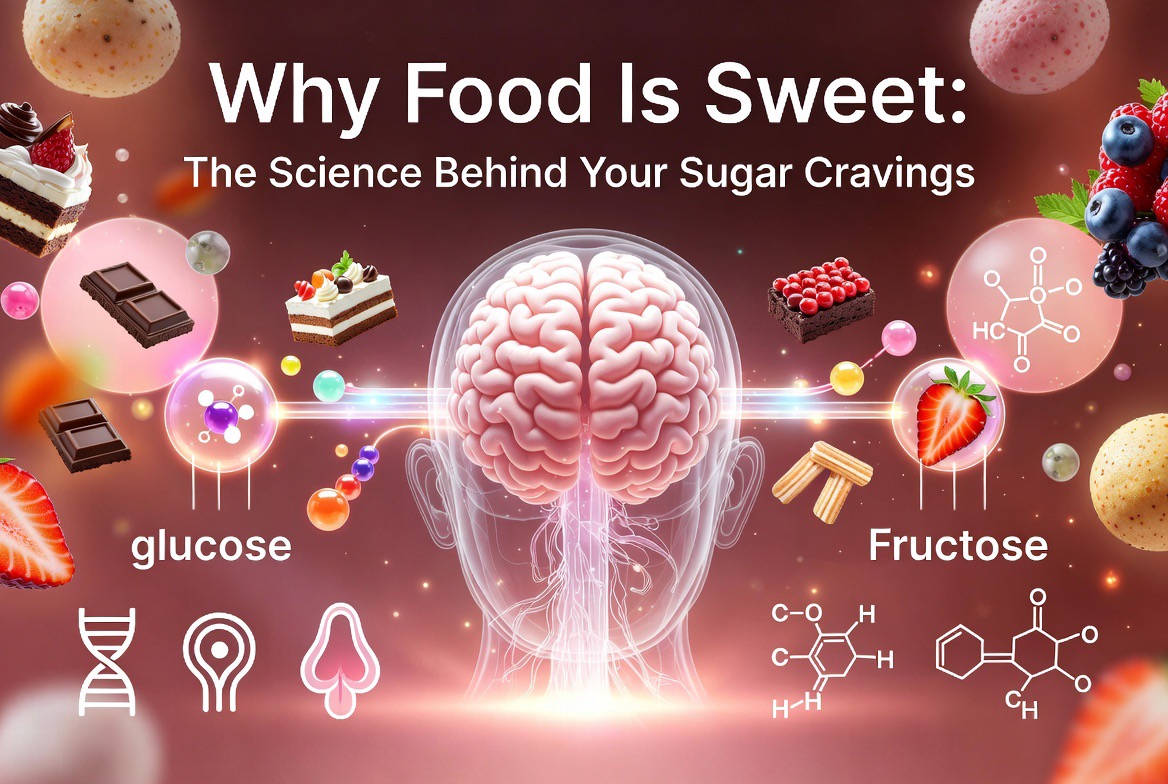
Why Food Is Sweet: The Science Behind Your Sugar Cravings
Discover why we crave sweets so intensely. From evolutionary survival advantages to dopamine-driven brain rewards and the clever science of taste receptors—this article reveals the fascinating reasons food tastes sweet and how it shapes our modern eating habits.
✍️ Guest post by SolanaForge — a contributor from the SparkIQ community.
Why Food Is Sweet: The Science Behind Your Sugar Cravings
Ever wondered why a single bite of chocolate or a ripe peach triggers an instant rush of pleasure? Understanding Why Food Is Sweet: The Science Behind Your Sugar Cravings reveals that our bodies are hardwired to seek out sugar. It isn’t just a lack of willpower; it is a complex symphony of evolutionary biology, molecular chemistry, and neurological rewards that has kept the human species alive for millennia.
The Molecular Basis: What Makes Food Taste Sweet?
At its core, sweetness is a chemical conversation between a molecule and your tongue. Most sweet substances are carbohydrates containing specific arrangements of atoms known as hydroxyl groups (-OH). For a substance to taste sweet, these atoms must fit into a "lock-and-key" mechanism on your taste buds.
The T1R2 and T1R3 Receptors
Your tongue is covered in papillae, which house taste buds containing specialized G-protein-coupled receptors: T1R2 and T1R3. When you eat a strawberry, the glucose, fructose, or sucrose molecules bind to these receptors. This sends an immediate electrical signal through the cranial nerves to the brain's primary gustatory cortex, announcing: "This is energy."
Natural vs. Artificial Sweeteners
While natural sugars like glucose and fructose fit these receptors naturally, food science has created "keys" that fit even tighter. Artificial sweeteners like aspartame or sucralose are often hundreds of times sweeter than table sugar because they bind more intensely to T1R2/T1R3 receptors, despite providing no caloric energy.
Evolutionary Biology: Why We Crave Sugar
To understand the science behind sugar cravings, we must look at our ancestors. For most of human history, calories were scarce, and sweetness served as a vital biological "green light."
- Safety Signal: In nature, sweet things are rarely poisonous, whereas many bitter substances are toxic. A preference for sweetness was a survival mechanism to avoid lethal alkaloids.
- Energy Density: Sweet foods, like ripe fruits and honey, are calorie-dense. For a hunter-gatherer, finding honey provided a massive energy influx that could mean the difference between life and death.
Our "thrifty genes"—designed to store fat and seek high-calorie foods—were an advantage in the Pleistocene era. In today’s world of 24-hour drive-thrus, these same genes contribute to metabolic dysfunction.
The Dopamine Loop: How Your Brain Rewards Sugar
When you consume sugar, your brain releases a flood of dopamine in the mesolimbic pathway (the reward system). This is the same circuit activated by addictive drugs and gambling.
Research in Neuroscience & Biobehavioral Reviews shows that sugar triggers endogenous opioids and dopamine, creating a powerful feedback loop:
- The Hit: You eat sugar, and dopamine spikes.
- The Memory: The hippocampus records the experience so you can find that food again.
- The Tolerance: Frequent sugar consumption downregulates dopamine receptors. Eventually, you need more sugar to achieve the same "high," leading to a cycle of cravings.
Hidden Sugars and the "Bliss Point"
In the 1970s, food scientists perfected the "Bliss Point"—the precise ratio of salt, sugar, and fat that overrides the body's "I'm full" signals. This makes processed foods hyper-palatable and nearly impossible to stop eating.
Sugar is often hidden under over 60 different aliases:
- Maltodextrin: A thickener that spikes blood sugar faster than table sugar.
- High-Fructose Corn Syrup (HFCS): A staple in sodas linked to fatty liver disease.
- Barley Malt or Rice Syrup: Often marketed as "natural" but processed by the body exactly like sucrose.
Natural vs. Added Sugars: A Comparison
Is the sugar in an apple the same as the sugar in a donut? Chemically, the molecules are identical. Biologically, the impact is worlds apart. The fiber in whole fruit acts as a "metabolic speed bump," slowing sugar absorption and preventing the insulin spikes caused by liquid sugars like soda.
Glycemic Index (GI) Comparison
| Food Item | Glycemic Index (Approx.) | Primary Sugar Type | Fiber Content |
|---|---|---|---|
| White Bread | 75 | Glucose (Starch) | Low |
| Apple | 36 | Fructose | High |
| Table Sugar | 65 | Sucrose | None |
| Lentils | 32 | Complex Carbs | Very High |
| Watermelon | 72 | Fructose/Glucose | Low |
The Gut-Brain Axis: How Microbes Influence Cravings
Your cravings might not be yours alone. The gut-brain axis is a communication line via the vagus nerve. Studies in BioEssays suggest that gut microbes can manipulate eating behavior for their own survival.
Species like Candida thrive on simple sugars and can produce signaling molecules that mimic hunger hormones, "forcing" you to crave sweets. Shifting to a diet rich in fiber and probiotics can alter your microbiome and reduce these cravings.
Psychological Triggers for Sugar Cravings
- Stress and Cortisol: High cortisol levels increase the desire for "comfort foods" because sugar temporarily inhibits the brain's stress-response centers.
- Sleep Deprivation: Poor sleep disrupts ghrelin (hunger hormone) and leptin (fullness hormone). Sleep-deprived individuals typically crave 30-40% more carbohydrates.
- Childhood Associations: Using sweets as rewards creates neural pathways that make us reach for sugar during emotional highs and lows in adulthood.
Practical Strategies to Manage Your Sweet Tooth
- Crowding Out: Focus on adding high-protein, high-fiber foods first to lower the hormonal drive for dessert.
- Sensory Deception: Use spices like cinnamon or vanilla to trick the brain into perceiving sweetness without added sugar.
- The 20-Minute Rule: It takes 20 minutes for fullness signals to reach the brain. Wait before reaching for a second serving.
Frequently Asked Questions
 Why do I crave sugar more at night?
Your circadian rhythm naturally increases cravings for sweet, starchy foods in the evening to store energy for the overnight fast. Evening cortisol drops can also trigger a search for a quick energy boost.
Why do I crave sugar more at night?
Your circadian rhythm naturally increases cravings for sweet, starchy foods in the evening to store energy for the overnight fast. Evening cortisol drops can also trigger a search for a quick energy boost.
Is fruit sugar as bad as processed sugar? No. Fruit contains fiber, water, and phytonutrients that ensure sugar is absorbed slowly, preventing insulin spikes and inflammation.
How long does it take to stop craving sugar? It typically takes 2 to 4 weeks for taste buds to turn over and dopamine receptors to reset.
Why does bread taste sweet if I chew it long enough? Salivary amylase, an enzyme in your spit, breaks down complex starches into simple glucose while the food is still in your mouth.
Conclusion
Understanding Why Food Is Sweet: The Science Behind Your Sugar Cravings is the first step toward metabolic health. By recognizing the roles of dopamine, the gut microbiome, and food engineering, you can make conscious choices to satisfy your palate without the sugar crash.
Read next on SparkIQ
- How to Be Rich: Smart Strategies to Build Wealth in 2026
- Get Free Money 2026 Today: Legit Ways to Earn Free Cash Online
- Mila on Solana: The Complete Guide for Creators (2026)
About the author
SolanaForge is the author of this guest post. Learn more or connect with them at solanaforge.app/create.
Want your own byline and a dofollow backlink like this? Submit a free guest post on SparkIQ — it's free, fast, and permanent.