
How to Add Liquidity on Raydium: A Step-by-Step Solana Token Guide
A practical walkthrough for adding your Solana token to Raydium: pool creation, initial pricing, LP token burn, and the safety checks that keep buyers confident.
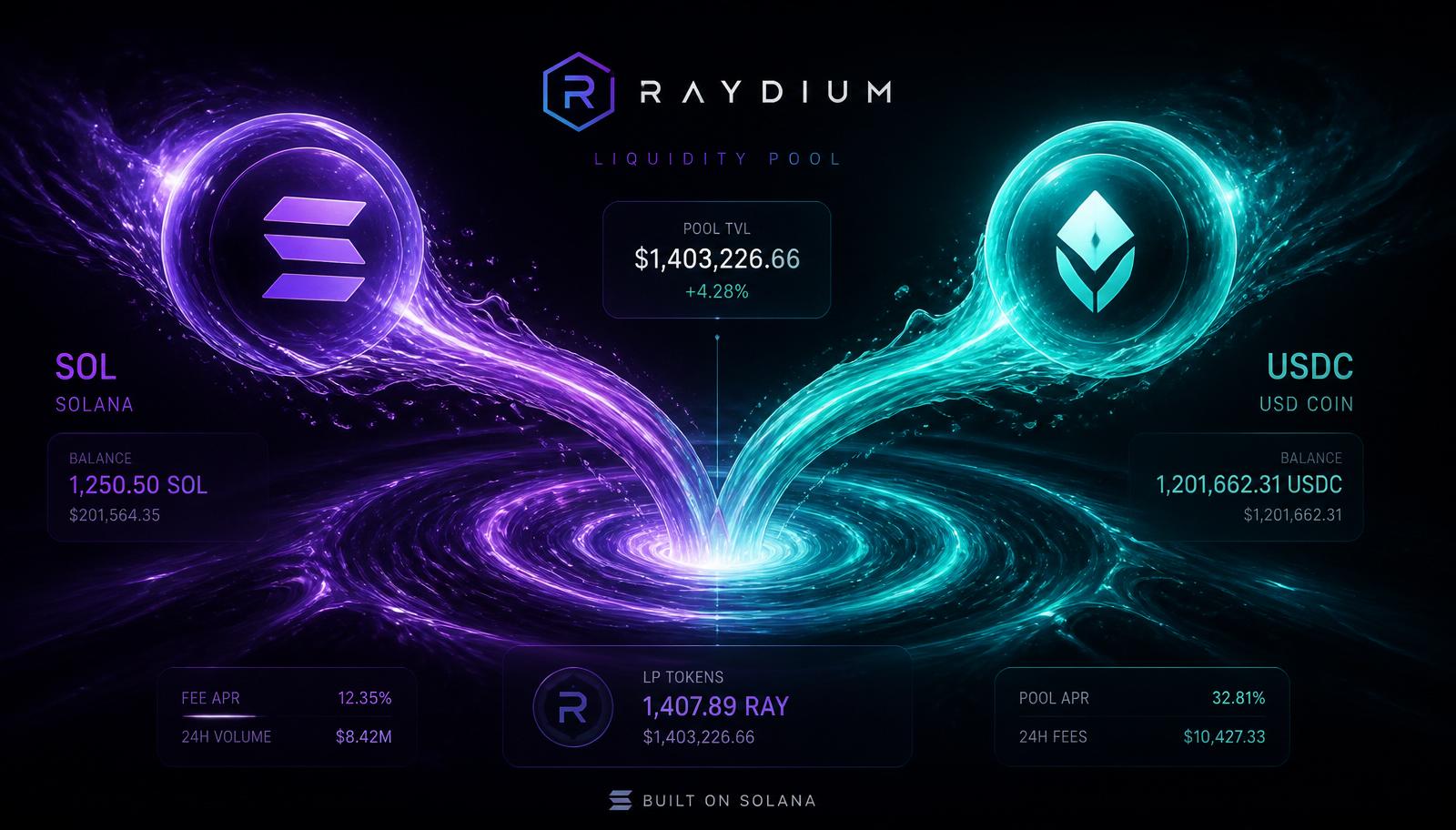
Minting a token on Solana takes five minutes. Making it tradable takes one more step: adding it to a liquidity pool on Raydium, the AMM that routes the majority of Solana swap volume via Jupiter. Without a pool, your token is just a mint address — no chart, no buyers, no price.
This guide walks through the exact flow for adding liquidity on Raydium for a brand-new SPL token, including pool type choice, initial price setting, and the LP-burn step that separates real projects from rugs.
Prerequisites
Before you touch Raydium:
- Your SPL token is minted and metadata is live (mint address in hand). If you haven't minted yet, use a no-code Solana token creator first — it takes ~5 minutes.
- Authorities are revoked (mint + freeze). Buyers check this before providing volume.
- You have SOL in a Phantom / Solflare / Backpack wallet: enough for the pair + ~0.5 SOL in fees.
- You control the token supply you plan to pool (usually 10–50% of total).
Raydium pool types: which one to pick
Raydium offers three pool structures. For a new token launch, only one is the right choice.
| Pool type | When to use | Fees for LPs |
|---|---|---|
| Standard AMM (CPMM) | Default for new token launches. Simple, deep, understood by every bot and aggregator. | 0.25% |
| Concentrated Liquidity (CLMM) | Established tokens with tight price ranges (stablecoins, wrapped pairs). | Variable |
| Ecosystem Farm | Adding incentives on top of an existing pool. | — |
For a new SPL token pick Standard AMM. Concentrated liquidity requires active range management — get it wrong and your entire pool ends up on one side of the market, killing trading.
Setting the initial price
The first liquidity provider defines the token's price. Formula:
price = SOL amount in pool / token amount in pool
Example: pair 10 SOL with 100,000,000 tokens →
10 / 100,000,000 = 0.0000001 SOL per token ≈ $0.000018 at $180 SOL.
Fully diluted valuation (FDV) at launch:
FDV = price × total supply
With a 1B supply at $0.000018 → $18,000 FDV. That's a reasonable stealth-launch FDV. Rules of thumb:
- $5k–$25k FDV — organic memecoin launch, room to run.
- $50k–$250k FDV — pre-seeded launch with marketing budget.
- $1M+ FDV — only if you have real product/utility to justify it.
Picking too high an FDV kills momentum instantly — no one buys the top of a chart they've never seen before.
Step-by-step: create the Raydium pool
1. Open Raydium's Liquidity page
Navigate to raydium.io/liquidity/create-pool/. Connect the wallet that holds your tokens.
2. Choose Standard AMM
Select the CPMM pool type. Set:
- Base token: your SPL token (paste the mint address)
- Quote token: SOL (or USDC for stable-pair launches, but SOL is standard)
- Fee tier: 0.25% (default)
3. Enter your amounts
Enter the SOL side first, then the token side. The interface computes the implied price. Double-check the FDV shown before continuing — this is the single most important number in your launch.
4. Set the pool start time
You can delay pool activation by up to a few minutes. Useful if you want to tweet the CA before trading opens so early buyers all hit the same block. Anything longer creates FOMO problems.
5. Confirm and sign
You'll sign 2–3 transactions:
- Pool account creation
- Initial liquidity deposit
- LP token mint (sent to your wallet)
Fees total ~0.3 SOL. Once confirmed, the pool is live and Jupiter will index it within minutes.
Burn or lock the LP tokens
This is the step buyers care about most. When you added liquidity, Raydium minted LP tokens to your wallet — these represent your ownership of the pool. Whoever holds them can withdraw the liquidity.
Options, in order of trust signal:
- Burn the LP tokens — send them to a burn address (
1nc1nerator11111111111111111111111111111111). Irreversible. Highest trust. Used by most memecoins. - Lock via a reputable locker — services like Streamflow or Team Finance lock LP for a set duration (3, 6, 12 months). Good for utility tokens that may need to migrate liquidity later.
- Do nothing — this is the definition of a rug-waiting-to-happen. Every serious buyer treats unlocked LP as an instant "no".
Whichever route you pick, screenshot the transaction and pin it in your launch tweet. On-chain proof beats promises.
After the pool is live
- Jupiter auto-routes swaps within ~2 minutes.
- DexScreener creates the pair page within
5 minutes — head there and update the token profile with logo, socials, and the "Update Profile" fee ($300 for the checkmark). - Birdeye picks up automatically.
- Photon / GMGN / Bullx — the trading terminals most traders actually use — index new Raydium pairs in real time.
Common Raydium pool mistakes
- Adding liquidity from a deployer wallet that also holds team supply. On-chain analytics flag this as concentrated ownership.
- Providing liquidity in the wrong ratio. If you deposit an odd ratio, Raydium recalculates and you set an unintended price.
- Forgetting to burn/lock LP before announcing the launch.
- Launching a pool with < 2 SOL of liquidity. Slippage on any real buy destroys the chart and scares off followers.
- Using CLMM for a new memecoin. Range management complexity kills the launch.
FAQ
How much SOL do I need to open a Raydium pool?
Around 0.3 SOL in fees plus your liquidity capital. Minimum credible launch: 2–5 SOL of liquidity depth.
Can I add liquidity later or increase pool depth?
Yes. Anyone can add to a Standard AMM pool at any time. You (or your community) can top up depth as volume grows.
What happens if I don't burn the LP tokens?
Buyers will assume the pool can be pulled at any moment and won't touch the token. This is the single fastest way to kill a launch.
Do I need to relaunch to fix a bad initial price?
No. Anyone can arbitrage the price by trading against the pool. But a bad initial price wastes your launch moment — get it right the first time.
How does Raydium interact with Jupiter?
Jupiter aggregates every Solana AMM including Raydium. Once your Raydium pool is live, Jupiter automatically routes swaps through it — you don't need a separate Jupiter listing to be tradable.
Can I add liquidity for a token I didn't create?
Yes, but you'll be permanently long the token relative to the pair. Only do this for tokens you're happy to hold.
Ship the pool
Adding liquidity on Raydium is the moment your Solana token becomes a real market. Mint it via a proper Solana token creator, pick a fair initial FDV, deposit liquidity you can defend, and burn the LP tokens the same session. Post the burn tx alongside the CA, and let Jupiter do the routing.
<!-- related-guides-solana-v1 -->
Related guides on SparkIQ
- Solana Token Creator: Launch Your Own SPL Token in Minutes (No Code) — the full walkthrough.
- How to Launch a Solana Memecoin in 2026: The No-Code Playbook — from idea to trading in one afternoon.
- How to Add Liquidity on Raydium: A Step-by-Step Solana Token Guide — make your token tradeable.
- Revoke Mint & Freeze Authority on a Solana Token (Why It Matters) — earn trust signals on RugCheck and DexScreener.
- How to Create a Solana Token in 2026: Complete Beginner Guide — the beginner primer.
Ready to launch? Use SolanaForge's Solana token creator — no code, no wallet exports, on-chain in under a minute.